Showing posts with label Masonic Practices. Show all posts

Thursday, February 29, 2024

To Improve Your Ritual...


undefined
Since I jumped in with both feet into yet another fraternal organization, I am again having to build up my memorization mind muscle. And since I have really been thinking of ways to memorize my new Odd Fellows work, I wanted to give a tip to all those brothers and sisters who are learning ritual. 

I start by using a method of listen and repeat; here's how it works. I begin this process by recording a very short part of the line. Then I go further in a very special way, I add a space between those short portions of the same length as the proceeding one. I continue through this process until I have completed the portion that I am attempting to memorize. If the lines are a part of a dialogue, I repeat the other portion in full and then leave a space for when I am to come in. It can be tedious to set this up but once it has, the real process begins.

I start the process from the very beginning. I then add a portion, bit by bit, until I am able to repeat that portion without the tape. I continue to do this until I have the entirety of the dialogue completed. It's the idea of chunking, building in those cues into the mind until they become second nature. And that's where the magic occurs. Once you have lines down, you can add the most important thing that most ritual I've seen is missing in just about every fraternal ritual I've seen, drama. We have such beautiful drama but without the actual drama, it's hollow.

I know this seems silly and I'm sure my readers with acting experience are probably already aware but for so many brothers and sisters, we are not trained dramatists. I truly want us to do whatever we can do to make our Art an art form!

Sunday, March 10, 2019

Guest Article: "The Problem with Banning Politics and Religion" by WBro. Robert H. Johnson


I am honored to be publishing a really intriguing article touching one of the third rails of Masonry by a friend of mine, WBro. Robert H. Johnson, podcaster and wonderful all-around brother. Enjoy!

It’s one of the first things we’re told regarding the fraternity, whether due to the instruction of a new member or explaining some basics to the profane (uninitiated). “We don’t discuss politics or religion in lodge. It’s divisive.” We may also hear something along the lines of, “No two topics divide men like politics and religion.” The hope is by adhering to these “rules” a more unified organization emerges. We as members of this fraternity are intended to be brothers, not in title alone, but in the fullest import of the term. We are to cry with our brothers, rejoice with our brothers, to be intimately connected with them—to have Storge. Storge is the Grecian term for a familial love. C.S. Lewis considered it, “... responsible for 9/10ths of all solid and lasting human happiness.”

This love is of the utmost importance. It provides a basis for our relationships and gently guides us in our actions when interacting with our members. Unity is the goal. We cannot have men angry with each other and also be unified, not in the way we want. We want to promote a unified vision of making good men better, of uplifting the human condition and the conscious mind. Above all, we treat our members as family. We are a diverse collection of people, who all have different backgrounds, customs and beliefs. Just like in the profane world where we have biological families with beliefs different from our own.

In our various interactions with family, do we stray from the discussion of politics and religion? In recent times, that answer is “Yes.” According to a 2018 CBS poll the majority of Americans don’t talk politics at the Thanksgiving dinner table. Currently political opinions are more than divisive, they are accusatory, they are defining, they are misunderstood. Absolutely polarizing and disruptive. This is a trend that has reached fever pitch in 2019.


The apprehension, fear and trepidation we have as a society in terms of the discussion of our ideologies and other beliefs stems from some simplistic shortcomings.

When discussions of any type are taking place there is an inability of the average person to listen, think, and ask refining questions as to the ideas being proposed. We hear a few trigger words and our attention is immediately drawn to our own minds, instantly retorting, and taking a series of mental tangents. We’ve lost the ability to ask and listen, and repeat.
Once we’ve heard the position, we can then ask the person, “Can you tell me if I understand you correctly?” Wrap up the position as you understand it and get that persons approval--”Is this what you mean?”. Then, if you disagree, present your position. This is proper, polite and allows us to grow through the mutual expression of ideas.
Secondly, we have a problem with cognitive dissonance. This is the emotional aversion to learning something which may not support or which may be in complete contrast to an idea we’ve spent years believing in.
A man goes to prison for a murder ten years ago. Eyewitness testimony along with top investigative work was used in the man’s conviction. The idea that this man was guilty was something believed by the prosecution. His conviction was proof of his absolute guilt. Years later there is an appeal. DNA evidence is available and for the first time, our convicted man has a chance to prove his innocence. The case is reopened, the DNA is tested and his innocence is proven. The man is still convicted in the minds of the people who put him in prison. This is an example of cognitive dissonance. When we fail to acknowledge new information regardless of what it means for us, we fail to progress mentally and emotionally.
If we may learn to address these things as a society, then perhaps there is a chance at growth and effective compromise. This however, is only a start.

Addressing Our Vulnerabilities

We have an inability to admit vulnerability to our peers. Specifically, we won't admit when we don’t understand something. There is no shame in admitting that we don’t understand a political or religious concept to our peers.

We all have apprehension in this, because by admitting we don’t understand something, we’re egregiously labeled as something, whether that's a “bleeding heart liberal” or a “bible thumping conservative”, choose your own insult here. Instead of assisting someone to understand, we label them ignorant and a part of the problem. This is wrong.

Strengthening the Mind

We have a general illiteracy of mind which is only further weakened by an inability or a willful ignorance to try and understand better. This “try” is an action--an exercise which without its use atrophies our minds and the consequence is a blank slate by which politically charged media may imprint their own version of events.

Succinctly, this is an eisegetical subjective message which is presented on a network, whether conservative or liberal. It will promote a way of thinking or narrative which is designed to either win over a simple mind or solidify the existing belief of the observer. The only way to combat this is to practice your own critical thinking skills. It’s hard. We all know the dangers of sharing articles on social media without reading them, basing our share on a great headline. This is relevant because this is an example of not critically thinking, not reading, not absorbing the actual information for yourself.

Consuming Ideas

It was not always this way. There was a time before social media, before headlines were underscored with the number of minutes it will take to read. e.g. “3 minute read.” appearing under an article posted to Facebook. In the past we would need to get the paper or book, open it and read it. Digest it, talk to our friends, family, neighbors, and coworkers in order to work the information over in our minds. To swish around the wine if you will. If we travel farther back in time, you could note that the title of books came at the end of the text. e.g. At the end of gospels, it might say something like, “This is the gospel according to John.” In this way, you would read the book, and then get a title. Today, we have a title and if not enticed by it, we pass it up.

In the days of yore, pre-internet, pre twenty-four-hour news coverage, I presume, evidence lacking, that we may have been better at discussion and critical thinking. Likely, because we had to be. Now we’re too busy to do our own research, to busy to form our own opinions and rely on what we trust to be accurate and objective news and information. Like Bing Crosby said in “White Christmas”, "everyone’s got an angle." You know who doesn’t though? You. Us. The only angle we might have is that of trying to understand and by our understanding, improve the outlooks and current conditions humanity is existing within.

What this does to the Fraternity

So why have we banned the topics of religion and politics within the lodge? They are divisive, yes, but only when we decide not to practice those first three pieces of the liberal arts and sciences. Those three arts whose foundation is predicated on faith in intent, hope in understanding and love of our Brother. The trivium-- Grammar, Rhetoric and Logic, which are glossed over in lodges and emphasis is almost entirely given to the quadrivium.. But let’s be honest, how many truly study these when we’ve been told to? What I outlined above are just a few techniques on how we can begin to utilize the trivium in order to understand and hold polite discourse with an objective of finding common ground and solve our issues.

Freemasonry is said to be a Progressive Moral Science. So much of what we speak about within the craft is of a language unknown. While we maintain that we understand the words and meaning, the reality is that we do not. We infrequently look at the meaning of the words within the time the words were written. Words change over time and so do their meanings. WB Scott Dueball is well known in my home jurisdiction of Illinois of explaining this to our constituency. A wonderful example is the word “Condescension.” In current use it is something negative. When the word was written however, it meant something wholly different. It meant to meet on the level.

Where It Comes From

Let us look at the words, Progressive Moral Science in their contextual use--that is, how those words were meant when they were written. This exercise will enable us to comprehend whether or not we are truly acting according to the dictates of Freemasonry, something we often are
concerned with, in other words protecting the vision as laid out by the sacrosanct documents; The Ancient Charges and the Landmarks.

The word “Progressive” has since the 1600s, been used in the majority of the time to describe idealizm and moving it forward. While this may not be news to you, it will be news to those who say the word “Progressive” is only meant to convey that we “Progress” from degree to degree. Because it’s more likely the former, when we say a “Progressive” moral science, we are setting the tone for a purpose. That purpose is to enact a system by which we may influence an idealizm that promotes acceptance and, social reforms. This point is further supported when we look at the next word, “Moral.”  

The word “Moral” can be traced to the 1400s and its use there is one depicting the ideal of character and the ideas one displays in his day to day life. His behaviors are defined as his morality. As we progress in time, likely to about the period the language was used within our fraternity, the word changes very little. It’s now taken on not only the behaviors, but also the concept of customs. Finally in 1752 we see the use in order to describe one's principles, good conduct and confidence. Interestingly it maintains the idea of customs as well, which is very relevant when we consider that there are various customs the world over. Further, that each of these customs is of a subjective nature in the country from which they were born. E.g. Does one use the left hand for a greeting? And if so, is that “Moral” in the region in which the greeting was given?
This information supports the idea that the word “Progressive” means or is tied to “Social Reforms.”

Next we must look at the word “Science”. From the mid 1300s, we see it used to describe knowledge, the application of knowledge and learning. This has remained the case to this day.
By this exploration, one must necessarily ask ourselves how we would practice this Royal Art? Obviously we are going to run into a conundrum. Don’t see it yet? Let us continue.

The Conundrum Explained

There is a point where our governments have provided us leaders through the process of democratic means. These leaders are titans built on idealizm and funded by donations from constituents, lobbyists and by companies. These leaders give us the laws by which we are to live and yet, where do they get these laws from? Our laws stem from, in most cases, our philosophical take on life-- the majority of this is given to us through our various faiths, and at other times, it is derived from simply reflecting on the human condition.

Our political system as it exists has taken on idealizm given by our religious texts.To make matters more complicated, it’s largely based on the issue of interpretations of those texts. This is human nature, to make sense of things and to want to govern and rule with a set of ideas which one believes in, to impart the best way of living, to promote the aforementioned idea of unity.

By nature, a government is to address the issues of the people. Our United States constitution gives us the right to “[...] life, liberty and the pursuit of happiness.” A sentiment similar in nature comes from Thomas Paine, in his book, The Rights of Man, in which he lists the role of government. In his case the British monarchy and parliament. “Government's sole purpose is safeguarding the individual and his/her inherent, inalienable rights; each societal institution that does not benefit the nation is illegitimate—especially monarchy and aristocracy.”

In order to assist the nation, a government takes it upon itself to address it’s social reforms, the “Progressive moral science.” Not surprising considering the Masonic connection to our country’s founding philosophy.

The Rub

So then, the eventual outcome is that religion has infiltrated the politics and has made the two inseparable. In addition the political system has taken on what the Masonic fraternity is charged to do. And, because these are now inseparable, we many not discuss the “Progressive Moral Science” in its proper context without violating our stand against the discussion of politics or religion in our lodges.

Today, if you tell me something you believe in, I can drop you into a bucket which would be labeled a broad definition of a political camp. Republican, Democrat but more likely, Liberal or Conservative, due to the extremism in America at the present. Alternatively, you could tell me which political party to which you are a member and I will guess your Religious alignment.

The Pew Research Center published a poll which gives us the data on this topic. Party affiliation has almost become the new religion due to the moral values which have been absorbed into the institution. A simple idea like assisting those less fortunate through a tax is Democratic and to support the those same people via voluntary donation is seen as Republican. The outcome is similar but the way we get there is different. The contention that exists is largely driven by the understanding of human rights as it pertains to our own property and its ability to be taxed or not, and a slew of other various philosophical minutia.

Returning to the beginning of this paper, I outlined a set of practices in which people could begin to hold social discourse and to work to understand each other. If we did this, could we then begin to talk about issues affecting society and raise more awareness than our tempers? I wonder if it’s okay to discuss in a tiled lodge, the safety of a group of local workers constructing a building? Could I do this in such a way, and organize a social program or even introduce a bill into local government to assist these workers? Could you use the Masonic lodge to speak to our benevolent minded brothers regarding a social injustice that’s happened in the community?

The answer is a resounding, “No.” There is a great confounding of politics and moral values. How do I know this? Because I have seen it shot down in lodge. Because I have seen men brought up on Masonic charges for attempting to practice the “Progressive Moral Science.” A simple idea to assist and organize something for the community, due to the local governments intellectual jurisdiction over all things relating to the welfare of her constituents is by nature political and as such, is banned from the local lodge. We’re left to donating money to benign causes. Donating money to organizations that do the work for us, and who likely contribute to the very politicians who promise to help. Have we abandoned Freemasonry’s original intent? Have we negated it completely? Or perhaps, is what we’ve been doing simply the best we can do since we’ve bound ourselves up?

A Charge

It’s my contention to assert a very real revelation. Directly, that by the exercise of removing our right to discuss politics or religion within a lodge, we have effectively neutered our ability to practice the Royal Art within the context of our original stated purpose. Abandoning our tradition, without ever even realizing it. On one hand we vehemently oppose changes to anything, on the other, we stand ignorant of what’s changed already and accepting of the limitations we put on ourselves.

If we are to take control and practice Freemasonry, then we ought to learn how to effectively communicate, listen, digest, ask further questions, listen again and comprehend. By this action, we may be able to have these discussions within a lodge and hence affect our local communities, truly working for the betterment of the human condition. Maybe even leaving the world a better version of what it was before we came into it. Perhaps instead of banning talk of a religious or political nature, we should instead train how to hold proper discourse?

Undoubtedly there is no recourse in separating political ideology from religious ideology. The bond is indissoluble. Perhaps rightly so. There are throughout the ages, philosophical discussions about whether humanity can have a set of morals without having a codified religious dogma from which it would be bourn. Again, two sides, who ardently disagree over the revelation of human rights, and morality.

In closing out this dialogue I wish to leave you all with an ask, and that is to be mindful. To listen before formulating a response and to attempt, however uncomfortable it may be, to see things from your fellow’s point of view. Walk a mile in their shoes, truly. Only through attempting this exercise in perception can we see the foundation of an idea all the same foreign to us, and from there, where we can align our values and endeavor to embody Unity. Then, we can practice Freemasonry’s Royal Art, the Progressive Moral Science.

Wednesday, August 30, 2017

Market Based Freemasonry and the Propagation of Lodges: Part 1


"Freemasonry is dying."
-That brother you chat with after lodge

How often do you hear that phrase? If you've been in Freemasonry for even a short time, I guarantee you've heard this. For whatever reason, a society built on traditions always seems to obsess with traditions, to the detriment of all other things. Freemasonry is no different.

I've been thinking about the various Masonic projects I've worked on, all those things that have increased or decreased my satisfaction in the Craft, and the one thing I always come back to is the thrill of the try. I love planning these things. I love seeing them happen, even when they don't work. And this brought me to something even more general, what I like most is making a market of ideas and events to bolster our underlying mission, to bring good men together of divergent backgrounds into a chain of union. We are, at our best, market based.

A friend and brother have been looking at ways of bringing market based solutions to improve Freemasonry. Here is our list.

1) Allow lodges to die quickly and easily. 

This is the hardest principle for our older members to accept. It makes sense, in a way. When you exert years of energy into a project, the mere thought that it could be discarded is a almost distasteful. But that's the problem. 

We have all been to a zombie lodge. Oftentimes, they continue to run into a wall. When new energy shows up, they gobble it up and that new brain goes away, either by leaving, or worse, becoming a part of it. A lodge like this should die. This lodge drags down Masonry by lessening the experience. And it's not just localized. Masonry, being a node based interconnected system, depends on the other nodes to pass information. If one node becomes slow, or weaker, more energy is applied with far worse results.

2)  Allow lodges to be born easily, with few restrictions.

On the flip side, we need to encourage new lodges. Lots of them. A market based system based on protectionism just increases inefficiency. Inefficiency is not a good thing. Progress is slowed. Innovation (the good kind) is stunted. We lose eager brothers behind red tape. 

Here are some examples I've seen in various Codes. Don't worry, I'll unpackage all of these.

a) New lodge must get permission from existing lodges.

b) New lodges cannot be within a set distance of another lodge.

c) Number of Master Masons signing exceeds, and in some cases, far exceeds the quorum requirements of existing lodges.

d) Restrictions on who can be the signer if the petition for dispensation, i.e. no elected officer in another lodge.

e) Subjective ritual standards that require near perfection of work by lodges UD inconsistent with existing chartered lodges.

f) Required to work in only Masonic buildings and with all paraphernalia at dispensation.

Before I get started, the funny thing is oftentimes, the fee itself to petition for a dispensation to form a lodge is almost a pittance, indicating to me that this economic protectionism in American Freemasonry was never originally intended.

a) New lodge must get permission from existing lodges and b) new lodges cannot be within a set distance of another lodge.

This boggles my mind. Why on earth would you give the organization most in need of competition rights over their competitor? If there is a subset of brothers so set on starting a lodge in the vicinity of another lodge, the likelihood is that there is either a) plenty of room for the both of them or b) a defect in the existing lodge. 

I get that. In how we are designed organizationally, we are a franchisee/franchisor arrangement. Restricting where a lodge can form creates huge sections of area that become unserviced by a Masonic lodge. That's economically wasteful. If a market exists and there is interest, we should be there. Instead, we'll have brothers driving 30 minutes, 40 minutes, only to sit bored. Time is value and lack of availability will immediately butt into that.

c) Number of Master Masons signing exceeds, and in some cases, far exceeds the quorum requirements of existing lodges and d) restrictions on who can be the signer if the petition for dispensation, i.e. no elected officer in another lodge.

These restrictions are often aimed at who can sign the petition for dispensation. And as you can see, these can get ridiculous fairly quickly. We already have a ritualistic/legal/traditional number of Master Masons necessary to form a lodge. It's seven. Seven. So, when you see 12.... 15.... 25!, even 50!, ask yourself, why?

The only reason I can think of is that, just like most protectionist laws, it starts with good intentions. Maybe the Grand Lodge brothers were worried about quality or sustainability. But now, these two become something far worse. Try starting a lodge that needs 25 Master Masons who are not elected officers. As someone who did, it's near impossible. If you can find one active Mason, he will, more likely than not, be one of those five things.

Even worse is that you also try to grab brothers who are MINOs, Members in Name Only. Getting across the finish line requires just getting names on a sheet of paper. That's no way to build excitement while the lodge project is under dispensation. And worse, it's a fiction as well as to encourage potential bad faith attempts to start a lodge.

e) Subjective ritual standards that require near perfection of work by lodges UD inconsistent with existing chartered lodges.

I am a ritualist and I absolutely believe we should demand high quality work. But, since this is a franchise relationship, the base standards should be the same across all locations. Basing the base performance of a new lodge at the desired standard while allowing other lodges to essentially skate is patently unfair and a barrier to growth.

To fix this, the standards should be clearly defined. It should be an objective standard or at least one reduced to the ability to open and close the lodge.

f) Required to be in Lodge buildings with paraphernalia

Hold on while I hold my head.

"Hi, I'm a new lodge. I have a building agreement in place with a Masonic building with all the paraphernalia in place."

Really? We have hundreds of buildings that can be rented so why do we need to be trapped in a Masonic™ building? Private rooms should suffice. More protectionism to prevent flexibility.

We can do better in that regard. We can make lodges vibrant by accepting the market.

Stay tuned for part 2 where I lay out the ideal market based lodge creation which I call the Flexible Lodge

Comments? Leave a comment below.

Thursday, September 17, 2015

Project 353: Sharpening Our Knives


Bro. Matt has written our followup post answering questions and concerns some brothers have. Let's maintain a dialogue as we continue moving forward. You can also like our Agape Lodge Facebook page here.

Update


We've received a fantastic response to Agape Lodge from some very talented Minnesota Masons. We'll be announcing a planning meeting soon exclusively for those who have signed up, so if this is something you want to do, please fill out the survey HERE.


We've also received some confused, and even negative responses. This is okay. This is something new. Dare we say, this is even an *cue scary music* an innovation in Freemasonry!

New ideas get resistance. That's great. They should get resistance. You sharpen a knife against an
unyielding stone. I've written about this before on my own blog.

For those who are resistant to change, like our old pal, Brother George, we wanted to address some concerns that have come up.

Can a lodge move around? Don't they have to have a building?

Yes, a lodge can travel around. We have an extremely successful one in Minnesota already that operates in much the same way, Sir Winston Churchill Lodge. They mostly meet in brothers' homes.

Hmm...sounds clandy. Is it legit? 

Good question. Let's ask one of its members.


...seems legit.

Okay, but can you meet in restaurants? 

It's a hurdle, no doubt. There has always been resistance to meeting in public places, but we believe that a well-tyled lodge actually takes a little effort. If we can tyle a quarry, or a hotel ballroom each year, we can tyle a banquet room with one or two doors.

Will you be drinking during meetings?

We're not serving alcohol during meetings. We will adhere to all rules regarding alcohol set by the Minnesota Grand Lodge AF&AM.

So you don't think a building is important for Freemasons?

We don't think it's important for every Freemason, for sure. Both Nick and I love our temples, and having a hangout is important for masons, but what we're trying to do is normalize the option of having different types of lodges, because we don't believe in the one size fits all concept of freemasonry. We think that lodges could certainly meet downtown on people's lunch hours, in a meeting room. We think that lodges can meet in peoples' homes or bars.

My lodge needs dues from all two-hundred of our members to stay alive. How are you going to make it with just a few guys?

We think that lodges can exist that have purposely low membership. They can make easier, faster budget decisions, and essentially have the power and ability to be what the members want it to be, without having to worry about angering a hundred other brothers who don't show up, but whose dues you can't survive without.

I'm worried this lodge will fail and that will damage Minnesota Masonry.

We're in this for the long haul, but I can't hold your hand and promise that everything will last forever and ever. Lodges fail.

Right now, sadly, we have a situation in place where Masons feel shame for a lodge that shuts its doors, and that they have failed in some way. Brothers, a lodge only fails when its brothers fail to become better men, and that happens in some of the biggest, oldest lodges in the world. Why do we worry about this?

Our ancient brethren would travel to many places and receive a charter to organize for a specific purpose; for building a specific structure. When they were done, the charter was dissolved and they traveled to new lands, chartering new lodges. That's ok. That's actually how it's supposed to work.

We think lodges can be convened for specific, limited purposes. As long as they're doing the work of the craft, they're succeeding.

Will you meet in a different place every time, or will Agape meet in the same place or same places regularly?

Totally up in the air right now. This will necessarily be a group decision, which is why it's so important that you be part of the conversation.

Will you be initiating, passing, and raising new Masons?

It's definitely something we want to do. As we're going to mainly be an affiliate lodge, it's probably not going to come up a lot, though we may certainly be open to courtesy work for other lodges. Eventually, if successful, we may bring in new masons of our own who find this format appealing.

Can you do degree work at a dinner table. 

Absolutely.

Hmmm...sounds clandy.

Then our Grand Lodge is clandestine, because they actually have a First Degree Table Lodge that your own lodge can perform any time it wants, and you can read all about it HERE.

This sounds elitist and stuffy. Is this going to look like something out of Downton Abbey?

You know, the state doesn't really have a dearth of scotch and cigar lodges. We're feasters. Some of that is going to include education on table manners, both modern and archaic, but it's probably mostly going to look like a good old family dinner or Thanksgiving. It should be pretty working class and on the level.

Ok, but if you're not like the other lodges, and don't have buildings to take care of, what could you possibly be doing in these meetings?

Like all lodges, of course we will have bills and general business. We'll just be discussing them over appetizers. But mainly, we educate! In our mother lodges both me and Nick are pretty proficient at leading group discussions, Socrates cafe style, about masonic issues. When we need a well-directed,
productive discussion about masonic symbolism, we'll be at work with the worshipful master leading the group. When we need a more vibrant back and forth, we'll be at refreshment where it's more of a free-for-all.


Why have a lodge at all then? Why not just have a supper club with a bunch of smart-talking masons? 

We want to form a lodge for the same reason that our ancient brethren formed lodges. Benjamin Franklin could have stuck with his Leather Apron Club, discussing news, science, and philosophy over a pint at the local tavern, but he decided to become a mason, because ritual and structure is important. And that's the thing. There are a lot of rituals that we can inject into our lives that remind us to be mindful, and we're going to be exploring those, and the rest of freemasonry, around a dinner table.

Why start a new lodge? If you think meetings are dry, horrible affairs, why not fix your old lodges?

Let's be clear on this point. We find no flaws with our lodges (Braden Lodge and Corinthian Lodge). They are vibrant centers of ritual, education and fellowship. We have everything we need there. We want more of it. Sorry. I guess we're greedy. We want more great freemasonry.

Do you have other questions or concerns? Please ask them! Interested? Come and be a part of it.

Memento Mordere


Thursday, September 3, 2015

Project 353: Agape Lodge


This is a guest post from my good friend and brother, Bro. Matt Gallagher of Braden Lodge No. 168. He also blogs at Stones 'n Bones. This post is about the lodge he and I are putting together and need your help. Yes, you.

Freemasonry adapts. Before our warehouse/office complex masonic centers, before our once lush, now crumbling masonic temples, brothers would gather where they could, settling themselves on pickle barrels on the second floor of a Five and Dime, educating and bettering themselves. And before that, the tavern lodge, where brothers would meet in a well-tyled tavern or public house. These were as much social gatherings as stated meetings, and education continued well past the rap of the Master's gavel, into the late, late evening over dinner, drinks, and strong black coffee.


It is in the spirit of this tradition, perhaps not "traditional observance" in its modern usage, but in its colonial one, that we're launching an expedition to explore newer, more flexible, and more self-sustaining lodges.

Project 353: Agape Lodge

Agape is a concept lodge exploring the ritual of feasting. Meeting monthly, likely on a Saturday night, nine months out of the year (we'll be dark January, July, and August). The winter and summer feasts of St. John will be our mid and end-season finales. 

How is this different than my current lodge?

First, at this stage Agape should be a mason's affiliate lodge. While we would like to reserve the right to perform table lodge degrees, a fully armed and operational masonic lodge, as you probably think of it, is not something we can initially, or even want to be. So if you get a lot out of your current lodge, think of us as premium bonus. 

Second, all the work will happen around the dinner table. We're not the first in Minnesota to do this, but we hope to be the best. The lodge will open, do business, call to refreshment, eat, call again to labor, have education, and close, all around the table, and not necessarily in that order, all in compliance with Minnesota Grand Lodge requirements.

Third, this lodge will be small and flexible. We may choose a single location meet, or move around. We haven't decided yet, but that's the point. We don't need to put anything in stone, and we don't need to be tied to expensive buildings or restrictive leases. We will be serious and elegant, but everything we need should be able to fit in the back of a minivan.

How is this the same as my lodge? 

It's pretty much the same thing, just more personal and flexible. We'll have lodge furnishings and regalia, but adapted to our use. We'll have committees, and business to attend to. And we'll have education in the oldest classroom on Earth: the supper table. The master of the lodge will not just conduct rituals and degrees, he will conduct exciting and on-point conversations about the Craft. 

You have questions. Ask them. But what we need, in order to explore the best answers, are interested parties. Dues are expected to be easily manageable, and ideally all-inclusive. Easy-going conversationalists are a must!

If you are interested, please fill out this brief survey: PROJECT 353: AGAPE LODGE

We hope you can join us, and if you can't, we at least hope you can support us. Freemasonry isn't the building, it's the brothers, and the work we do.


Memento Mordere... Remember to chew!

I don't normally do this with guest articles but seeing as how I'm also extremely involved in this very cool project, I just wanted to drop a note. Agape Lodge is one lodge in a series of lodges that we (a certain unnamed Mason and I) are calling Lightweight or Micro Lodges. The goal is to think smaller and grow smarter. An article describing the principles and tenets of lightweight lodges will be forthcoming but please be patient. The specifics are still being designed and worked out.

Comments? Post them below.

Thursday, April 2, 2015

Great article in the April 2015 KT Magazine

I know I give the Managing Editor some ribbing (earned and unearned) but I find myself completely agreeing with his latest paper, which can be found on page 9 of this month's (April 2015) Knight Templar Magazine. The title of the paper is Masonic Philosophical Differences in the 21st Century by John Palmer. It's a definite must-read.


What do you think of the piece? Leave a comment below.

Tuesday, March 17, 2015

When the Honeymoon is Over


As I get farther and farther away from my date of initiation, I'm starting to see the Fraternity differently. I can get a little sad and nostalgic over my past steps in Freemasonry, especially those initial steps. All of us, at some point, get past the Masonic honeymoon.

I think most of you will get where I'm coming from. You start off, not knowing anything about Masonry. The excitement of the Craft is overwhelming. Since, Masonry requires the petitioner to come forward, he is the initial spark. I remember my first step came when I chatted with my grandpa about Masonry. He was never a garrulous man so, for me to learn this fact was eye-opening. (there are still things I'm learning about him.)

Then the whirlwind romance with Masonry began. I got my petition and started the process. I visited the lodge my grandpa's friend recommended. I loved it. The early 20th c. layout of the building was incredible. Then I visited a number of the brothers and found a home. I fit right in. The degree work started and I was totally impressed.

I met my mentor, Don, and found someone I could respect as well as learn from. I kicked butt in my memory work and discovered that I was a ritualist. Masonry was this thing that filled a gap in my mind and heart that I never knew existed. I was in heaven. I'd learn another piece of ritual and get super excited. This would lead me to read books, a little Pike, a little Mackey, a lot of Pound. My wife can attest to my library growing to several volumes of Masonic material. I just couldn't stop.

I went through the chairs. I bounced up chairs, learning and loving every minute. Even my time as Master was fun. Then I entered the downward phase from the high as Master. My lodge has the bylaws set to have the outgoing Master serve as the Lodge Education Officer and the outgoing Lodge Education Officer serve as Marshal to ensure some level of continuity in the line.

And then, my year as Marshal was done. My career in my lodge was now Past Master. That was it. Cue whatever the opposite of swelling music is. I sat in my chair at home and thought about everything that had happened in my near decade in Masonry. The honeymoon was over.

Although I was active in Chapter at that time, it still felt like the air had left the balloon. I felt like a left-handed monkey wrench. Was I even necessary to my lodge? I know that's a little self-serving but I do think like that sometimes.

I think we all get wrapped up in these things that affect our identity and take a lot of our time. I couldn't stop thinking about Masonry, even keeping me up at night. I spent hours in my car learning ritual. But, sometimes, I will sit back and think, "were those hours wasted? Did I really spend my time well?" I think those questions are important to ask, especially to keep your sanity.

Once you get past that honeymoon phase, you have to focus on maintaining the relationship, similar to a long time friendship or a marriage. Not everything is love and affirmation. Sometimes it's work, sometimes there's stress. Sometimes you get excited again for something you're doing together. But a lot of it is maintenance.

That's why I think we see a lot of guys fade out in five to ten years. It's not just that we need mentoring; it's not just focusing down at the newish Mason past his honeymoon with the Craft from the organization, it's also counseling the newish Mason that his attraction to the Craft will wax and wane. Sometimes Masonry is just going through the motions. Sometimes it's as exciting as hell as you discover something new. But it's not a climb up, it's just a rolling wave through your life. And that's actually Masonry's greatest power.

We can walk away from it for a time. We can put it on hold. We can come back to it. We can keep it on a low boil. But no matter what, Masonry's always there.

So, my advice as a guy who has passed that honeymoon phase. Just roll with it. If you need to take a breather, take a breather. If you want to chat with your brothers, go ahead and find out what they do to just keep going. Masonry is like a friendship or a marriage, you have to work at it to keep it strong and healthy.

What do you think? Leave a comment below.

Monday, January 12, 2015

Masonry Around the Dinner Table


I have been delving deeper into my faith lately. I have begun to attend church regularly. I've even done extensive research into the various different traditions found within the Evangelical Lutheran Church of America. During my meanderings online, I arrived at a very novel concept for a church, the Dinner Church. The church I am referring to is St. Lydia's in Brooklyn.

Each Sunday, at dinnertime, the congregants of St. Lydia's come together around a dinner table as the participate in a religious observance from the earliest days of Christianity, the agape feast. They sing songs and participate in Holy Communion as well as to share blessings and joy with each other. It is worship around the table.

Alright, usual disclaimer, Masonry is not a religion. Now that that is out of the way, I was thinking about this idea, Masonry around the dinner table. This isn't new. In fact, Masonry was performed in conjunction with food. We can read in old exposes the brothers rearranging the floor for degree work by moving tables out of the way, points in the expose when the stewards would refill tankards and places where the meal would be served. The first Grand Lodge was founded so that the Masons of London could get together to eat, drink, and be merry. Masonry and conviviality were nearly synonymous terms.

St. Lydia's approach, of sharing a meal and worshiping, is really intriguing to me, both as a Lutheran and as a Mason. My lodge, during my year, had two table lodge/Entered Apprentice degrees. It was incredible. The tl;dr, if you don't want to reread that post, was that we held a meal during the degree work. Here, in Minnesota, we have a program that allows for this. But why does it only need to be for degrees? Why can't we have a dinner in conjunction with every lodge meeting? Why do we separate the two?

Think about it for a second. Instead of stations and places, instead of a huge open space where everyone is a yards away from each other, we sit shoulder to shoulder, passing around food and drink, sharing in fraternalism in close proximity. The ritual can be done in this manner, was done in this manner, and, I'm gonna say it, should be done in this manner.

Too often, we see Masonry as this experience that is dry and boring. Minutes are read and business done. We may have a paper and we may even have a guest speaker. But all of these, every single one, is passive. We listen, we sit, we listen again, we close. We may as well have the lodge arranged as a high school classroom and issue hall passes. It doesn't have to be this way.

Imagine instead a lodge room, tables set out with food and refreshments. The officers arranged as we do now but at a table, on the same level. We open, we dine, we discuss, we close. Two hours of food and fun, enlightened discussions and fond farewells, as the Tyler's Toast is delivered and we all sing Auld Lang Syne. You like that, don't you? So do I.

We don't need to separate dining and lodge. We can do both simultaneously. This can be all one experience. Masonry is designed to bring us together. That's its stated purpose. We can bring our Craft back to its roots in a meaningful way, seeing each other as brothers, sharing our food, and sharing our time. Let's shake off the mundane and bring on the new; lodge as an experience instead of a lodge as drudgery. This can happen. This is possible. And this can be fun. Let's continue to build Masonry up, and have fun along the way. Let's eat, drink, and be merry, just like our speculative brothers did more than 300 years ago.

What do you think? Should the meal and the meeting be combined? Leave a comment below.

Wednesday, December 10, 2014

Exit Interviews Upon Resignation


I was reading the Q4 Communications Report of the Board of General Purposes and was struck by this passage:

RESIGNATIONS FROM PRIVATE LODGES UNDER RULE 183
"[...]London and many Provinces now operate a system of ‘exit interviews’ with the aim of ascertaining whether a resignation is owing to a general disillusionment with Freemasonry, or is related to the particular lodge of which he is a member. In the latter case it is often possible for the Metropolitan or Provincial authorities to find a more convenient or congenial lodge for the Brother to join so that his masonic career is not interrupted[...]"

 This is pretty interesting. The idea of an exit interview to ascertain why an employee is leaving a job is very common. However, I've never heard it used in a Masonic context. I think it's pretty genius.

We all know brothers that joined and left within a couple years. However, I've never seen any lodge ask why. I didn't during my year. And now that I see this, I really wished that I had.

We fail a lot on this front and blame the brother who is leaving. This is a two way street. We may be able to find something better for him. Or find out what we, in general, need to do to make Masonry relevant. And this could even be expanded from the lodge level to all Masonic organizations.

I'm going to be recommending this to the Worshipful Master of my lodge and maybe even the Grand Master. I think it's the right thing to do.

What are your thoughts? Do you think we need to conduct exit interviews for the brothers that seek to demit? Leave a comment below.

Tuesday, July 22, 2014

The Continuum of Freemasonry


I've been in Freemasonry for nearly a decade now. Since my first day as a Mason on a cold day in early February, I have been learning and growing, talking with other Masons online and in person to get a sense of what Masonry is. What I have learned from all these years is that Masonry is not one thing but many things.
I was feeling a little nostalgic so I started looking at old blogs that I used to frequent during my own early years as a blogger and arrived at Thomas Munkholt’s excellent Grail Quest site. I have been reading a lot about the Swedish Rite lately because 1) I really like it and 2) because I wish I could bring it to my jurisdiction. (That’s a subject for another day) I started reading comments and ran into this one by Chad Simpson:

“I read your comments regarding the concern of some Freemasons for the exclusively Christian nature of the Swedish Rite.
Having shared that concern at one time, I can only say that Freemasons at their best are traditionalists and at their worst are provincial.
Because of the emphasis that Freemasonry places on tradition, it is very easy for the untraveled or unread Freemason to believe that every Lodge is just like his own.
In fact, it is often a shock for a Brother when he finally realizes that Freemasonry is as diverse as are Freemasons themselves.
Though universality is an essential element of Freemasonry under most Grand Lodges, it is understandable why the Swedish Rite has developed as it has.
Though I enjoy studying the various forms of Freemasonry–variety being the spice of life after all–I must confess that I enjoy most a familiar dish.”
                                Source

I think the commenter is onto something. I think we, as Masons, even with our ability to travel, like to stay within the familiar. I find this most especially on sites like the Freemasonry subreddit. Nearly every day, brothers will tell other brothers that what they are doing, whether it be mouth to ear ritual education or some other subject that is different from their own jurisdiction, is wrong. That’s right, just plain wrong.
It makes sense why these feelings exist. We are usually laboring in the quarries in our own jurisdiction. Sure, the random business trip may take us to a place where a lodge is actually meeting that night and that we have the good fortune to have remembered a business suit to be able to attend but, for the most part, we stay within the walls of our own Masonic experience.

I think the most common topic, the one that generates the most heat on nearly every forum I’ve ever been a member, is how religion, in particular, how Christianity, should fit within the Masonic system. Because of our history, the nature of religion (especially Christianity) and the Craft is very important to understanding development of the Craft degrees, the various side degrees, side orders, rites, and even the youth groups. It is very misunderstood as it varies among all the jurisdictions.

I think the best way to think about the varying viewpoints is to place them on a continuum. I choose a continuum because, it is most basic, using a continuum presupposes that all data in the set share some common theme, in this case, the fact that all of them are Masonic. On the left most side, we will place the Swedish Rite. On the far right side, we will place so-called “Adogmatic Freemasonry”, of which the Grand Orient of France would be an example. Between these two points, we can arrange the various rituals. Preston-Webb would be near the center as would Emulation and its many variants. In fact, most, including the Swedish Rite, would be clustered near each other.

My supposition is that wherever you are on the continuum, both based on your own experiences in Masonry as well as in which jurisdiction you were raised, will affect how you view other practices of Freemasonry. If you believe that God (or a Supreme Being) is an essential aspect of Freemasonry, any practice that does not recognize His importance in the work will not be considered regular in practice. And depending on how far you are away from another practice will likewise determine how uncomfortable you are with a Masonic practice. That’s why, at least in my opinion, many brothers within Preston-Webb will denounce Swedish Rite as unMasonic. And this is even more pronounced if that brother is not Christian. Of course, this always means that compared to Swedish Rite, some brothers may feel more comfortable with “Adogmatic Freemasonry” than to any practice that restricts membership to Christians. You’ll find statements like, “why can’t we use a blank book?” to be common with the compelling argument of having it represent all VSLs.

I point out this continuum because I think we, especially we Americans, get lost in the world. Most of us, including myself, have never traveled to a foreign location in our lives. It’s sad but true. Because of that, we become, just as the comment states above, provincial in our way of thinking and we shut ourselves off from the wider Masonic world. Universality within Freemasonry was not a given and even Anderson backed away from perfect universality when he released his revised 1738 Constitution. It’s difficult. Universality is just one of the goals of Freemasonry and it wasn’t, and has never been, universally accepted.

The Antients disdained the Moderns and that grand body’s rejection of nearly all Christian allusions. Even at the merger, the Antients felt it important to insert language acknowledging the chivalric degrees practiced by so many Antient lodges and chapters; "[t]his article is not intended to prevent any Lodge or Chapter from holding meetings in any of the degrees of Chivalry, according to the Constitution of said Order." It’s a tug of war match between those that seek to acknowledge the Christian origins of the degrees and those that would like to remove them for a new universal philosophy. And that tug of war continues.

These feelings manifest themselves within a jurisdiction. The most apparent example in my jurisdiction is Commandery. Commandery is decidedly Christian and has a long history. Yet, many brothers will denounce it as unMasonic, placing it somewhere between Freemasonry that allows women in and whatever Leo Taxil had in mind when he wrote his hoax. It’s one of the few bodies that I've seen actively derided. I used to be bothered by this but then I thought of the continuum.

I don’t find the Commandery or Swedish Rite or Rectified Scottish Rite as offensive because I am a Christian. Yet, I can also understand why some Masons may have a problem with it. It’s restrictive by its very content. The Crusades were a destructive series of events in the Levant. Yet, the chivalric degrees are also very much Masonic. They are both historically and traditionally relevant within the body of Masonry.

Masonry is vast. If our lodges symbolically extend into the deepest core of the Earth all the way into the Heavens, then it will most assuredly pick up all those practices and styles. Knowing where you are on the continuum is the first step in seeing the wider world, understanding which practices make you comfortable, which practices or styles make you uncomfortable and ultimately understanding why. For me, I cannot accept Adogmatic Freemasonry as regular because I feel that Masonry is a Deity adoration society. By first knowing where I am on the continuum, I am forced to articulate reasons for why I don’t like a practice, in this case, the removal of God from our ceremonies. It also gives perspective as to why another person may accept some practice with which I don’t agree.

I don't think we need to accept every practice in Masonry but we should at least know why a practice, qualification, or some other Masonic tic that differs from our own may not be totally unMasonic. The Commandery exists, it has Masonic roots, and even though it restricts membership to only those adhering to the Christian religion, I would consider it Masonic. The Rose Croix, as it’s called in England, only accepts Trinitarian Christians, unlike its counterparts in the United States; I would also call it Masonic. The Grand Orient de France removed mention of the Great Architect of the Universe from its constitution; I would consider that practice to be irregular but I think analyzing the reason why Frédéric Desmons, a Calvinist Priest, instigated its removal is important.

Masonry is vast. Yet, within its vastness, it’s still held to the aforementioned continuum. Try for yourself. I've found that by arranging Masonic rituals in this way, I've learned tolerance for all of Masonry’s windings.

What do you think? Where are you on the continuum? Where is your Grand Lodge on the continuum? Does the continuum help you? Leave a comment below.

Monday, April 21, 2014

One Book to Bind Them

The Altar at my Lodge
I have been giving thought to religious tests. The United States Constitution forbids the use of religious tests to be an elected official for federal office. Sadly though, we may not allow them de jure, I have sensed that the public demands a de facto religious test, at least for the office of president but I digress.

Our own Masonic Fraternity turned away from a religious test, at least through the Moderns, when the first edition of Anderson's Constitutions of 1723 were approved by the Premier Grand Lodge of England. The very first charge reads:
I – Of GOD and RELIGION.
  • A Mason is obliged by his Tenure, to obey the moral law; and if he rightly understands the Art, he will never be a stupid Atheist nor an irreligious Libertine. But though in ancient times Masons were charged in every country to be of the religion of that country or nation, whatever it was, yet it is now thought more expedient only to oblige them to that religion in which all men agree, leaving their particular Opinions to themselves: that is, to be Good men and True, or Men of Honour and Honesty, by whatever Denomination or Persuasion they may be distinguished; whereby Masonry becomes the Centre of Union and the Means of conciliating true Friendship among persons that must have remained at a perpetual distance.
This was a fascinating addition to Masonry. It also began a strongly heated battle for supremacy in English Masonry. The Antients took great offense over the removal of Christian symbols in favor of a religion in which all men agree. In fact, the Antients were appalled that the Moderns allowed non-Christians to become Masons at all. The religious nature of Freemasonry was a major bone of contention which led to the disagreement.

I have wondered if we, even now, carry on this strange Antient versus Moderns fight, of where religion may exist, of whom may or may not be a brother. I think it is safe to assume, particularly after reading a few letters to the editor in the KT Magazine, that some brothers would rather see Masonry be a single, homogeneous group, dedicated to the worship of Christ alone and not to that religion that all men agree.

Is there a solution? I was noodling this idea. In using a VSL for our brothers to swear an oath on, we allow whatever holy book would bind him to his oath. Instead of focusing on the exact nature of what he is swearing on, what if we standardized one book to be used in all obligations? All lodges would be required to swear candidates only on the King James Version of the Bible.

Whoa?! Didn't he just say that we shouldn't Christianize the Craft?

Now stick with me. The thing is that when we ask a candidate what book he would like to be sworn on, it immediately calls the question of what religion he is. The Volume of Sacred Law is a symbol just like everything else. By viewing the KJV Bible as just a symbol in the Work, we remove the religious distinction from the candidate.

Furthermore, those candidates that profess a belief in God but remain unaffiliated to any particular religion will not be required to then declare one. It also increases the anonymity of faith, allowing all brothers to meet on the level, without distinction as to politics and religion.

On the other hand, by restricting candidates to one VSL, he may feel that his oath is not legitimate because he is not swearing on the book he holds dear. It also may lead to the same belief that I see in the Knight Templar magazine, that Masonry is a Christian organization that was kind enough to allow other men. Personally, I prefer the idea of the cultural mosaic over the melting pot. When we place different VSLs on the altar, we are making a quilt of connection, sewn together as much by our differences as our similarities.

It's difficult to weigh both the desire for inclusiveness without distinction. I'm not sure what the answer is but I fear the Antients and the Moderns are still fighting to this day. Perhaps the future will be different.

What do you think? Should we use only one VSL or should each candidate be allowed to choose based on his religious belief?

Wednesday, September 18, 2013

High Church - Low Church and the Masonic Meeting

As is probably obvious from my posts on joining Commandery, I would describe myself as Christian. My Christian path as a child wound through many different church cultures and traditions but all of them were decidedly Protestant, and particularly focused on worship unbounded by strict formalism. However, as I have been exposed to different worship services and styles, I have found myself gravitating to what might be described as "high church" or "broad church." (In this case, I'm not describing doctrinal high church, rather formalism in the church service.) Sometimes, this is pejoratively styled, "smells and bells." And apparently, I'm not alone.


This is an example of High Church.

According to a post entitled, "Young Evangelicals Are Getting High" on the Christian Pundit website, a number of evangelical Millennials are dumping the traditions of their youth for Roman Catholic, Anglo-Catholic, or High Church Lutheran services. They are attending Evensongs, participating in Ash Wednesdays, and other ancient traditions of the Church.

The author, in fact, is puzzled by this change.
In a way, it’s hard to understand. Why would you trade your jeans, fair-trade coffee, a Bible and some Getty songs for formal “church clothes”, fasting, a Bible and a priest? It makes no sense to want to kneel on a stone floor instead of sit in a comfy chair. And if you’re hearing about Jesus anyway, why does it really matter?
My teenager years were spent in a Methodist church. I'm used to rock bands, fun youth pastors, Christian rock stars, and blue jean wearing parishioners. Yet, when I attend a service like this now, it feels incomplete. Sometimes I wonder if the main reason people attend church is to hurry up and get to the coffee.

I attended a worship service awhile back and the pastor was going a little long. Well I guess he was going long but I didn't notice. I was enthralled because he was explore doctrinal ideas and issues that I had never heard in a sermon. He was exploring Christianity. He wasn't the Bible thumpers of television, he wasn't the storytellers trying to compare God to a caddy, etc. No, he was shaking the contents of the Bible out and looking at how it mattered.Yet, I was distracted by the coughing, watch-looking congregation. Weren't they listening?

I was frustrated. Here was a very young pastor who was exploring his faith and letting us in on the ride. In fact, he was giving a very good lecture on doctrine. The congregation was furious. They just wanted in, they wanted out, they wanted to go and chat about this or that, and then they wanted to go home.

This isn't to say that I haven't gotten something out of non-traditional, evangelical, or "low church" services as well. There have been moments of ecstatic faith. Moments of finding God within the service itself. However, I'm finding fewer and fewer of those moments within less tradition-rich environments.

So how does all this relate to Masonry? Right now we see various types of Masonry. There's standard lodges, there's Traditional Observance, European Concept, Restoration, and Affinity just to name a few.

I view Masonry through the lens of tradition. I think, in the Fraternity's transformation from the pre-World War II era to the post-World War II era, something was lost. The Fraternity ebbs and flows often. You know, maybe that's not the right phrase. The Fraternity is a double edged sword; on one side, it's a search for philosophy, for meaning, in other words, an introspective journey, and on the other side, it's a search for fraternal love, belonging, in other words, a community building organization. Frankly, we've been cutting with the fraternal side so much, it's becoming dull and blunt.

We live in the era of the 50's. The 50's era brought a lot of men into the Fraternity. They were good men for the most part but the lodge became very fraternal. That period did not bring a lot of different thoughts, of traditionalism. It was about easy opens and easy closings to focus on the lodge business, electric lesser lights, printed ritual, and a relaxed dress code. It was good for those men. I would argue, however, that some of us in the younger generation are not looking for that.

My optimal Masonry is focused almost solely on education, ritual, and tradition. In my mind, I see real candles for the lesser lights, formal dress (not tuxedos because they have been done to death), classical music or even better, organ music, incense, and deliberate take on the ritual. It's not that I want to make Masonry into a church. Masonry is not a religion. Instead, I want more focus. I don't want business meetings that drag on, I don't want brothers to look forward to the outer lodge because the lodge experience itself sucks.

Nothing I'm saying can't also be achieved in a less formal setting. A lodge that breaks itself of the useless business is on the right track. A lodge seeking to make education the highlight of the meeting is doing it right. Pancake breakfasts and reading the minutes and financial reports is not the right way. I don't want more Masonic business, I want more Masonry. Or maybe even better, I want the business of the lodge to be speculative Masonry. These can be accomplished in both high Masonry and low Masonry. I enjoy lodges in both traditions. It's the deliberation that the brothers make to the Work that makes a great meeting.

I understand that my view is not everyone's view. I might be just a tool. But I know what I like, and I think a number of younger Masons are in agreement. Tradition, focus, and education are essential. We have to make our meetings meaningful or men will turn away from the front porch, to find it elsewhere.

We are a society dedicated to self-improvement. This self improvement comes from external sources, our brothers, our ritual, or our explorations of our traditions and history. Even something as small as a candle helps me to focus my thoughts to the work at hand. For me, Masonry is work, not a chore. This isn't to say that I don't want Fraternalism. Masonry isn't just a "fix me" organization. We should have a good time. We just need to focus on both sides of the blade so as to not dull one side or the other.

What do you think? Are you a Mason in one of the aforementioned lodge types? Why or why not? Am I way off base? Leave a comment below.

Thursday, September 12, 2013

Wednesday, May 1, 2013

Appointed as Grand Representative

File:Hans Holbein the Younger - The Ambassadors - Google Art Project.jpg


I am excited to announce that I have been appointed as the Representative to the Grand Lodge of Quebec.

Many brothers seem unaware of the concept of Grand Representative. According to Section G1.09 of the Minnesota Masonic Code, a Grand Representative is "authorized to extend the fellowship and good will of the Grand Lodge and to protect the interests of the Craft of this Jurisdiction, as occasion may require." Essentially, a Grand Representative serves as an ambassador for the foreign Grand Lodge to the Grand Representative's Grand Lodge. I'm still learning the position but I'm pretty excited to extend a Brotherly hand to brothers in another jurisdiction.

If you are in the Masonic Light program under the Grand Lodge of Minnesota, one of the competencies is to serve as a Grand Representative and exchange correspondence annually.

Are you a Grand Representative? What has been your experience? How has it enhanced your Masonic life? Leave a comment below.

Tuesday, March 19, 2013

An Idea for Lodges: the Free Little Library

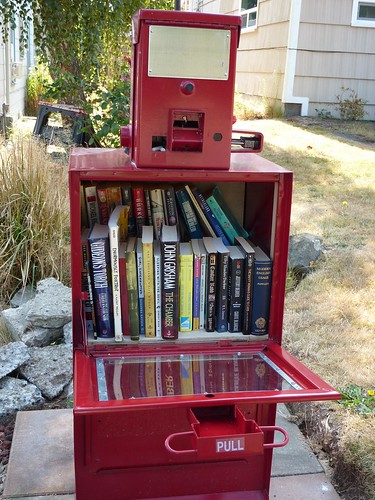
Little Free Library #1967

For some reason, Masonic buildings seem to be on two ends of a spectrum. On one end, the building is imposing, i.e. the Detroit Masonic Temple. On the other end is a building like my lodge's, a facade that disappears into downtown. In both cases, the community can feel a bit put off. So, what do we do? A lot of lodges smartly host community events, meet at neighborhood functions, and perform other outreach ideas. But there are always more good ideas that we can employ.

One idea that is coming out of Hudson, Wisconsin that is garnering a lot of attention is the Little Free Library. The concept is relatively simple. A neighbor puts a box that resembles a dollhouse on top of a post. Inside the small house is a shelf or two of books. The books are donated by the community, including the Steward of the Little Free Library.

At least from all the articles, once the Little Free Library is installed, the community starts to come together. It becomes the community watercooler as people gather to see what books are there and to chat about what's going on in the neighborhood. The library is filled with an eclectic mix of donated books and the books are labeled with the phrase, "Take a Book, Leave a Book."

I was thinking about how this idea could be used by Masonic lodges, especially those with front lawns. Think about it. The Little Free Library could be filled with interesting Masonic tomes, books about self improvement, Dan Brown books, or whatever the lodge that meets there thinks is a cool idea. The Little Free Library is cheap to build and can be made with recycled material. The cost for registering it on the map is a paltry $34.95.


I think this idea is great. Just think, a nice looking box of books open to the community to share would be something unique and acceptable to the neighborhood. In one article I read, a comment is made that the Little Free Library is like a porch that extends to the street. I think this is a wonderful community outreach program that doesn't cost much money and would extend porch of King Solomon's Temple to the street. Let's make this happen.

What do you think? Should Masonic Lodges put Little Free Libraries in front of their temples? Leave a comment below.

Sunday, November 25, 2012

The Case for Candles

Courtesy of Unizar Lodge No. 347


Brothers,

I've been thinking about the constant tug-of-war between tradition and modernity in our Craft. It's an interesting issue that continues to arise as the modern world outside the lodge and the traditions within the lodge either clash, merge, become accepted practice, or exist yet are ignored. Case in point, candles.

At the beginning of speculative masonry, lodges used candles as the lesser lights. This was obviously out of necessity. The only way one could light a room effectively was using candles as the long lasting and practical Edison incandescent light bulbs would not be invented until the late 1870's. Candles were the thing to use, it was just that simple.

As with all modern advances, the light bulb began to be adopted en masse as Edison and several competing inventors changed the way we viewed light, the night, and time. Of course, this modern advance finally found its way into Masonic lodges.

I haven't found any source material on when most Masonic lodges in my state switched from candles to incandescent bulbs but it must have been very nearly after when the incandescent bulb was invented and mass produced from age of the lamps I have seen. I can't be sure why bulbs were chosen but I wish to speculate. I believe the reason was to save time.

If you've ever seen a lodge with candles and not bulbs, you have probably noticed the biggest difference when lighting the lesser lights. The candle route takes time, at least two minutes for the Senior Deacon to go from candelabrum to candelabrum while a lamp takes, well, a second. Flick. Now the lesser lights are on.

In this case, switching from our old way to light the lesser lights to this new way has not improved the lodge experience. In fact, I'm going to go further and say that the bulbs have done nothing but to remove an important symbol from our lodge.

The lodge visits I have attended that employ candles change me somehow. Both methods of light come from the energy of the sun but only with candles do I sense kinetic energy. Candles, with their dancing flames, placing light in seemingly random sections of the Lodge Hall, changes my experience. The candles encourage action, sharpening my mind in a way a light bulb never could. In fact, I would say, I put no thought into the lesser lights when a lamp is used. None. They are just a perfunctory step to opening and closing.

Tradition and modernity can work together. Lodges can and should have lodge websites. If a lodge wants an organist but can't find one, using a prerecorded track may be okay. These tools allow lodges to accept a changing world without losing everything that Masonry should keep.

Modernity should not force its way in, disrupting what is strictly not its purpose. I can imagine that at some point, a lodge will attempt to use a Kindle, its screen set to "Always On", as a representation of the Holy Bible. I suspect, that some brothers will attempt to record the ritual and have candidates watch a screen, thus, losing that important connection of ritual to self-transformation.

As with all things, we must take care not to lose our traditions. We must always balance why we do things with what we can do after advances in technology take hold. I do believe that we can create a balance, we need only be cognizant and vigilant at every meeting.

What are your thoughts? How do we effectively protect our traditions and accept helpful technological advances into our lodges? Leave a comment below.

Monday, June 25, 2012

One of the Best Masonic Weeks... Ever

It's been awhile since I posted last. I have been extremely busy with my family, my Lodges, my Chapter, and my Council. However, all that work and good cheer has culminated in one of the greatest weeks I have had since I first petitioned my lodge. Where to start? I guess from the beginning.

On Saturday June 23rd, the Grand Chapter met for its Annual Convocation. This year was the 150th Annual Convocation. Our Grand Chapter had some business that it hadn’t had in more than sixty years. Our Grand Chapter chartered not one but two new Chapters, Overseers Chapter No. 103 and Anoka-Shekinah Chapter No. 104. I have now seen two lodges and two chapters receive charters in the state of Minnesota. This should end all the doubtful talk out there that Masonry is dead. There is fervency and zeal in Minnesota Masonry. What a proud day.


Companions of Anoka-Shekinah Chapter No. 103

Companions of Oveseers Chapter No. 103

Oh, oh, oh, and there was that little thing about Corinthian Chapter No. 33, the Chapter that I happen to be the High Priest of, was just award the membership award for last year for the highest net increase in membership. Hughie and I were completely without words... for about a minute. It’s because of the dedication of the companions in Corinthian Chapter and many great friends of the Chapter (James, thank you) that we are thriving. I know we will continue to serve as a beacon for Capitular Masonry with many petitions signed and petitioners ready and willing to jump into this major undertaking.

Okay, now that I’m done talking about Chapter, let me talk about my Saint John the Baptist’s Day. My wife and I woke up and got ready early on Sunday. Our son woke up just a little later. We were getting ready to go to church. But this wasn’t just a normal Sunday, this was June 24th, the Feast Day of Saint John the Baptist, one of two patron saints of Ancient Free and Accepted Masons. We hopped into the car and drove to Faribault.

I entered the Faribault Masonic Temple not really knowing what to expect. I’m a member of two lodges and Faribault No. 9 happens to be one of them. We had been throwing out an idea of reviving an old tradition of Masonry. There is documented evidence that Masons would, on the Feast Day of Saint John, process to a house of worship. We finally felt that we should and could do something like this. We received special dispensation to open our lodge, call to refreshment and process to Our Merciful Savior Episcopal Cathedral.

I’m not an Episcopalian. However, I do know about Our Merciful Savior because of its connection to a very prominent Minnesotan. Our Merciful Savior served as the cathedral for Bishop Henry Whipple. Bishop Whipple is best known for pleas of clemency to President Lincoln for 303 Eastern Dakota men who had been put on trial and sentenced to die as a result of the Dakota Wars that raged through the state of Minnesota. President Lincoln commuted 264 sentences but allowed 38  prisoners to be hung in the largest mass executions in American history. The memory of that sad day remains in Minnesota even now. Here is a copy of his letter to President Lincoln. This was a man holding to his principles against the hostile winds of Manifest Destiny.

Here's a video about Bishop Whipple and the Cathedral:


Going back to the Procession, I found it amazing that a mere twelve brothers could do something as historic as this. With our piper at the head of the line, our Master next to the Chaplain holding the Holy Bible, we began marching down the street. The walk was beautiful and the downtown quite empty. As we crossed Central and saw the Cathedral’s bell tower in view, I finally felt the historic nature of this event.

We entered the Church to the sounds of of a bagpipe echoing off the vaulted ceiling. Again, I had never seen an Episcopalian service before so it was a very new and richly rewarding experience to see how others worship G-d. The Worshipful Master was introduced and invited to give a few words. Worshipful Master Jimmy gave a short and respectful address explaining who we were and why we were there.

After the Church service ended, we assembled and processed back to the Masonic Temple. Of course, now the sleepy town had awoken and it was fun to see the confused faces as we walked back to the door. We closed the lodge, changed cloths, and had a picnic at the park across the street from the church.

Assembling Outside of the Church Before Processing in
Sorry for the, “and this one time at band camp” feel of this post. Right now, all I can think of is what we have done not what it means yet. I’m still wrapping my head around this. Everything we did was positive and it’s hard for me to get fully grasp right now.

We are starting to plan our next year’s Saint John’s Day procession. My hope is that we make this an annual event. Thanks to Our Merciful Savior Cathedral for allowing us to join you, thanks to all the brothers who attended and as always, a special thanks to the families that came, especially my wife, the love of my life.

Friday, March 9, 2012

UGLE's "The Future of Freemasonry" Report


As noted in the BBC News' article from yesterday, the United Grand Lodge of England has released a report today concerning the state of Freemasonry and its future in the country of England. You can read the report above.

What do you think? Leave a comment below.