Brother Jack Roberts is a great thinker in Minnesota Masonry. I am ecstatic that he's agreed to write an article for this blog. Thank you Brother Jack.
In a recent post on The Millennial Freemason, W. Bro. Nick Johnson discussed whether our lodges would be more successful if they adopted a “theme model” instead of a “destination model.” He stated that “a lodge needs a hook…something that captures the attention and wonder of a man…to keep singing the song of Freemasonry in his heart.” W. Bro Nick gives the example of a lodge adopting a theme as its hook, such as using British ritual and dress, or following the principles of the Traditional Observance Lodges as outlined by the Masonic Restoration Foundation. I left a comment to W. Bro. Nick’s post, and he asked me to expound on my comment by writing a guest post for The Millennial Freemason. I appreciate this opportunity, W. Bro. Nick. You should be commended for giving someone the “floor” on your blog who does not necessarily agree with you.
In my opinion, theme lodges and affinity lodges are an unfortunate formalization of the ongoing dance we do to completely avoid the reason the Craft exists and our required work. Freemasonry already has a theme. It is identical across jurisdictions and time: to provide men with the knowledge and assistance to achieve self-enlightenment and constantly move along a road of self-improvement. At best, a theme lodge is one of many tools we use to assist each other to move along this road. At worst, it is a distraction and a sales gimmick wrapped in a fancy label.
In my 12+ years as a Master Mason, I’ve seen a growing tendency for lodges to compete with each other on a variety of selling points: convincing a Brother to join a lodge across town because it has “better” fellowship than his local lodge, or “better” ritual, or a “more traditional approach.” In our more passive-aggressive moods, we simply state “we stress fellowship at our lodge…” Theme lodges, for the most part, are just another form of self-advertising, targeting a niche audience – “we dress better than other lodges,” and “we use fancy European ritual – no Preston-Webb work here except when Grand Lodge makes us use it.”
Somewhere along the way, we sacrificed the foundation of why meet as Freemasons – our “theme” – by elevating how we achieve our goals to supreme importance. Fellowship, ritual proficiency, and unique themes have become the reason for existence for many lodges. Lodges spend their time and effort to being the best or most unique at everything except what truly matters.
We sell Masonry under the oft-quoted maxim of “making good men better.” The all-too-familiar rant against our Craft is that we consistently fail to follow through on this sales pitch. We fail to teach and encourage each other to live our principles. We fail to consistently provide our members with the intellectual support they need to improve themselves. Masonic “education” is seen merely as an elective course, to fit in the schedule if we have time, but it is never to prevent us from planning the next cook-off or cause our meeting to run too long and interfere with our post-lodge fellowship. We perpetuate the neglect of our true purpose with a smoke-and-mirrors approach, throwing ritual, fellowship, titles, charities, and – our latest fad in Minnesota – theme lodges, at Brothers, while ignoring the hard work of actually challenging men to develop spiritually. What benefit is it to us if we restrict our Masonic dealings and efforts to topics that deal with nothing more than the outer, and not the inner man?
Some Brothers may argue that they enjoy spending time with “like-minded men” who appreciate ritual like they do, or British regalia like they do, etc. etc. Brothers, every lodge is full of like-minded men. The beauty of Freemasonry, one of our hallmarks, is that it brings together men from all walks of life, where we meet upon the level and part upon the square.
Brothers, I am not arguing that theme lodges are a bad idea. If they can use their themes in a way that fulfills the ultimate purpose of Freemasonry, then they should be commended, as should any lodge that accomplishes this purpose. But a Lodge with an absence of education, a lodge that focuses on the how at the expense of the why, a lodge that does not provide the means for its Brothers to improve spiritually – this lodge is failing at its mission, no matter how formally its members dress, what form of ritual it uses, or how often its Brothers meet for dinner and call it “festive board.”
Bro. Jack P. Roberts
Nicollet Lodge No. 54, Saint Peter, MN
High Priest, Minnesota Chapter No. 1
Illustrious Master, Saint Paul Council No. 1
Monday, August 15, 2011

Tuesday, August 9, 2011
Destination or Theme
So, I’ve been thinking about the way things were and the way things are now. For at least a few centuries in this country, the lodge was thought of as a destination. Rarely did lodges meet in the same building and the idea was that a lodge was recognized as successful once it could afford its own lodge building. Lodges in the country were the place where all the local businessmen, farmers, lawyers, doctors, and other well-to-do men would meet and talk shop. Lodges in the city were neighborhood lodges and functioned very much like their country cousins, living in the community.
Now, many lodges in America can no longer afford the upkeep of a building as they struggle to be relevant in the modern age. The car has made traveling much faster and easier thus increasing the distance a brother can go to his home lodge. Is there a panacea to solve the loss of membership and the lack of interest within our own lodges? My thought is that we need to get away from the destination model and enter into the theme model.
The theme model already exists in many jurisdictions under the term “Affinity lodge.” Of course, I think using the term Affinity really limits what a theme lodge could be. It’s not merely providing one single common interest to mix the cement that a brother needs to stay in the house not made with hands.
Historically, lodges were a destination, a place to be and the relationships between brothers came from that geographical locale. Now, brothers join lodges that are not necessarily near their homes. They join where their friends are, an affinity lodge, or a lodge with a great presence, either on the Web or through some other public relations manner.
We don’t have a raising problem, we have a retention problem. So what do we do? Like any great song, a lodge needs a hook. It needs something that captures the attention and wonder of a man. But it’s not just about capturing his attention for the short term; he needs to stay engaged for the rest of his life. He needs a hook to keep singing the song of Freemasonry in his heart. I have been thinking about concrete, real world examples that will really help lodges.
One idea is to hold a degree or a mini school of instruction once a month, regardless of whether a lodge has candidates or not. Invite other lodges that have candidates to come down and confer the degrees as a courtesy. Let them watch what part of the degree is the main focus for your lodge. At the end of the degree, invite the brothers to give their impressions of the ritual, not just critiques of what needs to be improved but really delve deep into what the degree means. Young men, like myself, crave the ritual, and have a desire for learning. Encourage some friendly disagreement on what the symbolism means or allow a brother to voice his opinion on a Masonic subject. Lodges can be a place of different thinkers, all searching for common truth, even when we see it from a different perspective. Making the lodge a veritable School of Athens will encourage retention.

Another thought would be to create a distinct theme. In Minnesota, as I mentioned above, we have four lodges that are built around a single theme. Two examples are Sir Winston Churchill Lodge No. 351 and Saint Paul Lodge No. 3. Churchill Lodge bills itself as a British theme lodge (if there are any Scottish Masons out there, I think they use British as a term because we, in America, don’t see a distinction with being English or Scottish and being British). They wear English regalia and have lodge officers that would correspond to those in England. Saint Paul Lodge No. 3 is a Traditional Observance Lodge. It follows the rubric set out by the Masonic Restoration Foundation. These include a festive board, a chain of union, and a focused look at the performing the ritual and presenting scholarly papers. Both lodges have found success through finding a niche.
Lodges in the city should share space. This helps defray the cost of housing the lodge but also gives it the ability to share Fraternal bonds with the other lodges. We can't afford the one body, one building model anymore. Sharing the load can really help and also makes the building a place of gathering.
Finally, all lodges should be using social media and the Internet to connect with their members. Nearly every lodge brother has an email account. This means that sending an email to a lodge is easy and can get the word out quickly. And since lodges are drawing so many young people, lodges should have at a minimum, a lodge Facebook page (you can find Corinthian Lodge and Braden Lodge by clicking the hyperlinks). A Facebook page is free and can easily connect a new brother to his lodge. From there, lodges can and should create a true web presence, a website, to become the Internet front door for your lodge. My lodge, Corinthian Lodge No. 67, saw a huge increase in the number of interested men and members of the community wanting to talk with us because we had a website with a contact field. For more insights, please read Bro. Matt Gallagher’s article on using the Internet to improve your Lodge.
Lodges need to be different. We need to try new things to find our niche. Men are looking for different things from the Fraternity and lodges will need to adapt to survive and more importantly, to thrive. After the theme takes hold, your lodge will once again become a destination.
Do you have any thoughts about this article? What have you found to be successful in your lodge? Please post a comment below.
Now, many lodges in America can no longer afford the upkeep of a building as they struggle to be relevant in the modern age. The car has made traveling much faster and easier thus increasing the distance a brother can go to his home lodge. Is there a panacea to solve the loss of membership and the lack of interest within our own lodges? My thought is that we need to get away from the destination model and enter into the theme model.
The theme model already exists in many jurisdictions under the term “Affinity lodge.” Of course, I think using the term Affinity really limits what a theme lodge could be. It’s not merely providing one single common interest to mix the cement that a brother needs to stay in the house not made with hands.
Historically, lodges were a destination, a place to be and the relationships between brothers came from that geographical locale. Now, brothers join lodges that are not necessarily near their homes. They join where their friends are, an affinity lodge, or a lodge with a great presence, either on the Web or through some other public relations manner.
We don’t have a raising problem, we have a retention problem. So what do we do? Like any great song, a lodge needs a hook. It needs something that captures the attention and wonder of a man. But it’s not just about capturing his attention for the short term; he needs to stay engaged for the rest of his life. He needs a hook to keep singing the song of Freemasonry in his heart. I have been thinking about concrete, real world examples that will really help lodges.
One idea is to hold a degree or a mini school of instruction once a month, regardless of whether a lodge has candidates or not. Invite other lodges that have candidates to come down and confer the degrees as a courtesy. Let them watch what part of the degree is the main focus for your lodge. At the end of the degree, invite the brothers to give their impressions of the ritual, not just critiques of what needs to be improved but really delve deep into what the degree means. Young men, like myself, crave the ritual, and have a desire for learning. Encourage some friendly disagreement on what the symbolism means or allow a brother to voice his opinion on a Masonic subject. Lodges can be a place of different thinkers, all searching for common truth, even when we see it from a different perspective. Making the lodge a veritable School of Athens will encourage retention.
Another thought would be to create a distinct theme. In Minnesota, as I mentioned above, we have four lodges that are built around a single theme. Two examples are Sir Winston Churchill Lodge No. 351 and Saint Paul Lodge No. 3. Churchill Lodge bills itself as a British theme lodge (if there are any Scottish Masons out there, I think they use British as a term because we, in America, don’t see a distinction with being English or Scottish and being British). They wear English regalia and have lodge officers that would correspond to those in England. Saint Paul Lodge No. 3 is a Traditional Observance Lodge. It follows the rubric set out by the Masonic Restoration Foundation. These include a festive board, a chain of union, and a focused look at the performing the ritual and presenting scholarly papers. Both lodges have found success through finding a niche.
Lodges in the city should share space. This helps defray the cost of housing the lodge but also gives it the ability to share Fraternal bonds with the other lodges. We can't afford the one body, one building model anymore. Sharing the load can really help and also makes the building a place of gathering.
Finally, all lodges should be using social media and the Internet to connect with their members. Nearly every lodge brother has an email account. This means that sending an email to a lodge is easy and can get the word out quickly. And since lodges are drawing so many young people, lodges should have at a minimum, a lodge Facebook page (you can find Corinthian Lodge and Braden Lodge by clicking the hyperlinks). A Facebook page is free and can easily connect a new brother to his lodge. From there, lodges can and should create a true web presence, a website, to become the Internet front door for your lodge. My lodge, Corinthian Lodge No. 67, saw a huge increase in the number of interested men and members of the community wanting to talk with us because we had a website with a contact field. For more insights, please read Bro. Matt Gallagher’s article on using the Internet to improve your Lodge.
Lodges need to be different. We need to try new things to find our niche. Men are looking for different things from the Fraternity and lodges will need to adapt to survive and more importantly, to thrive. After the theme takes hold, your lodge will once again become a destination.
Do you have any thoughts about this article? What have you found to be successful in your lodge? Please post a comment below.
Wednesday, July 13, 2011
Tuesday, July 5, 2011
Castle Island Lodge U.D.

“So I visited a lodge in Manitoba.”
“Wow, Manitoba, isn’t that like 8 hours from your house? When did you find the time?”
“Actually, I visited the lodge in the spare bedroom of my house.”
“Wait, what?!”
I’ve had one of the most interesting Masonic experiences of my short time as a Freemason; I visited a virtual lodge. In fact, I believe I visited the virtual lodge, Castle Island Lodge U.D. The reason I say “the” is because I don't think there is another virtual lodge in the world.
So what is a virtual lodge? I would describe it as the next logical step after an Internet Lodge. An Internet Lodge is a lodge that is open to brothers of many jurisdictions. It is oftentimes seeking only brothers to affiliate or subscribe as degree work is not their focus. The lodge is instead a marketplace of ideas and a way for the fraternal spirit to spread across the world. An Internet lodge meets in the physical world but corresponds in a variety of Web based ways, email, message boards, etc. on daily basis. Some examples of Internet lodges are Internet Lodge No. 9659 and Lodge Ireland 2000.
A virtual lodge meets online. That's right, online. The brothers assemble online at wherever they are located. The meetings have a ritualistic opening and closing and the business of the lodge is dispensed in the same manner that a physical lodge would. It is a lodge in every sense of the word… well, maybe not every sense. This type of lodge begs the question: what is a lodge? Is a lodge the people or is the lodge the building? Or is it both?
Now for a little backstory: Castle Island Lodge U.D. is a lodge under the Grand Lodge of Manitoba. The name Castle Island originates from their first meeting location which was in Second Life. The lodge owned a virtual island that had a castle as its virtual meeting room and all of this existed within that virtual world. Second Life is a MMO World. describes it
Sidebar: I've used Second Life in the past and in some places, it has redeeming qualities but in many respects, the content and activities that go on in the Second Life world are, to put it delicately, weird.
I visited Castle Island Lodge during its June 29th stated communication. The manner in which Castle Island meets is through an online video conferencing service. I sent the lodge secretary a letter of introduction from my Grand Lodge and was invited to attend the web conference. We ritually opened and began the business of the lodge in the same recognizable format that thousands of lodges do each and every month. After all business was dispensed with, the lodge was ritualistically closed. The brothers performed the duties of the lodge as a lodge. There was a Worshipful Master, Wardens, Deacons, Inner Guard, and an Immediate Past Master. There was a VSL open with the square and compass. Every necessary component of a lodge was there.
This is an important first foray into combining Freemasonry and the Web. The Web is redefining our sense of place and our sense of time. We listen to podcasts and use DVRs. We use telepresence devices to conduct meetings from any place with Internet access or Skype or FaceTime to chat with family and friends. I would describe a virtual lodge as being a place on the Web, each brother tyling his own surroundings and within himself, guarding against the vices and superfluities of his life. Castle Island Lodge is breaking down the conception of what makes us Masons. Can Speculative Masonry work without a physical meeting place? Can we experience Freemasonry wherever we are so dispersed? I think the answer to both these questions is a resounding yes.
I really enjoyed my time with the brothers. I met Grands, Past Grands, and as well as officers of various lodges throughout Manitoba. I've met brothers dedicated to moving our Fraternity forward. I’ve seen a new route that Freemasonry is taking as she enters the burgeoning world of technology.
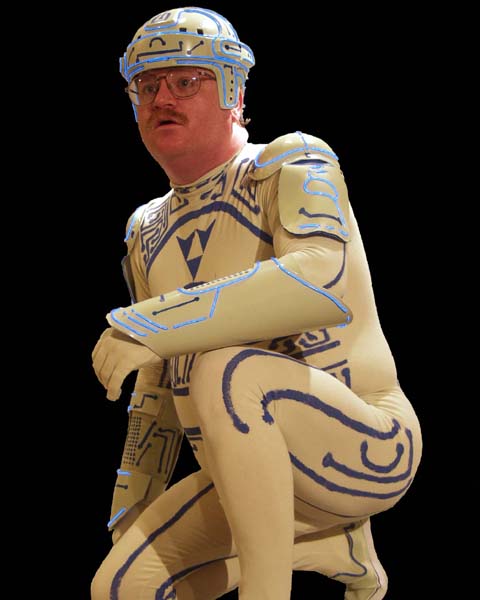 My opinion is that Grand Lodges need to encourage these types of experiments. Evolving doesn't mean discarding or ignoring what once was, is, or will be nor is Castle Island Lodge an innovation. I'm glad to see a Grand Lodge, like Manitoba, embracing something like this. I don’t think we need to completely dismantle the physical Masonic world and reassemble it online like the laser on TRON because we need those places as well. (I’m not going to lie though; I wish I could have a light disc and light cycle. Dare to dream.)I don’t see a virtual lodge as interfering with our practice or the only way that Masonry should be worked. What I do see it as is a new effort at making connections. That is what Masonry is all about.
When we enter into the lodge door, we enter in the same or similar manner as every other brother of that lodge. Our personal impressions and perceptions belong only to us but the process is completely set before we enter. I’m a man that sees Masonry as a process, not an outcome. Oftentimes, we are driven to outcome-only thinking, how many brothers were raised in a given year?, how much to charity have the members donated?, or how many lectures have we memorized?, but really that’s not the purpose of Freemasonry. We seek new places and new ways to further our light. It’s not the third degree as an end but as a beginning. We are a process-driven organization.
Castle Island Lodge is a new place and a new way for gaining light. The venue may be different but the process is the same. Who knows where this concept will lead except perhaps the Great Architect. But this is something that has to be done. We must investigate new ways of bringing light to brothers. Another lasting benefit is that our infirm brothers may continue to take part in our labors. A brother in a land that is not necessarily hospitable to Freemasonry can still find fraternity. And of course, I know my wife appreciated that it took me 5 seconds to get home.
Of course, some things can never be recreated in the virtual world. You cannot have a festive board with all the brothers assembled around a table. (Although you could each eat dinner and have toasts at each individual location) You cannot use all the modes of recognition and outer lodge chats don’t happen at the pub. I think all these are relative. A virtual lodge, and indeed any lodge with a different take on Freemasonry, will invariably lose one aspect to gain another. The Masonic world like the profane world is a series of trade-offs.
This isn't the one single answer to rule them all but this is an important thread to follow. The lodge will still have to perform the three degrees in the physical world. The lodge will still have to be installed in the physical world. That's okay with me. The idea that brothers from every corner of the globe can and will be available to labor and feel the fraternal bonds of our Craft is revolutionary.
As with all things on the Web, I was reminded by the brothers of Castle Island that this lodge is still improving, or in Google terms, currently in Beta. And just like a Google product in Beta, this lodge and its novel concept will continue to improve. All the parts are working and only minor tweaks will need to be made to be ready for primetime.
I will cherish the new found friends that I have met during my visit to Castle Island Lodge. I want to thank Castle Island’s Worshipful Master, M.W.Bro. Dave Love - (Grand Master in 2009-10)
and
M.W.Bro. Chibu Uson (current Grand Master) - Senior Warden
M.W.Bro. Steve Kane - Junior Warden & Treasurer (Grand Master 1995-96) current Executive Secretary of Grand Lodge
M.W.Bro. C. Rae Haldane-Wilsone - Secretary (Grand Master 1997-98, Gr Sec 2001-2010)
R.W.Bro Bernie Gross - Past Grand Director of Ceremonies and current Grand Historian
R.W.Bro. Norm Pohl - Chaplain (current Grand Chaplain)
R.W.Bro. Jake Mohns - Past District Deputy Grand Master and WM, Mystery Lodge #174 Thompson, Mb.
R.W. Bro. Fred Heinrihs
I will be visiting again in August and I'm very excited with the prospect of presenting an educational piece to the lodge. This is a brave new world but unlike Huxley's dystopian vision of the Fordian World State, technology is here and it's wonderful, ubiquitous, and game-changing. Thanks go out to all the brothers of Castle Island Lodge. I had a wonderful time.
If you’re interested in more information, please use the contact form here. Welcome Freemasonry to the Web, you’re really going to get along well.
Tuesday, June 21, 2011
A Plant of Deep Root...
Here is an interesting story coming out of the border regions of the Sahara. The people there are doing combat against the creeping sands destroying the arable land there. The weapon against this scourge, the acacia tree. Lines of acacia trees are being planted to keep the Sahara at bay.
You can read more here. Truly, a plant of deep root.
H/T to WM Steve B.
Subscribe to:
Posts (Atom)





 Posts
Posts


